Protests Won’t Bring Down The Iranian Regime
The downfall of the Islamic Republic will be nasty, brutish, and likely long.

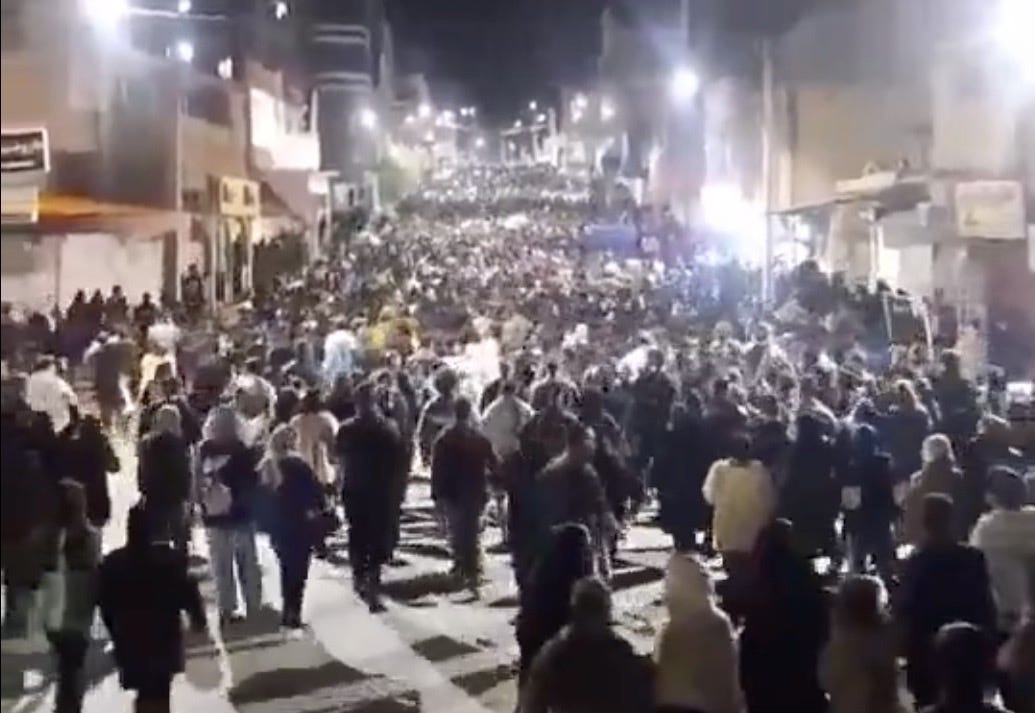
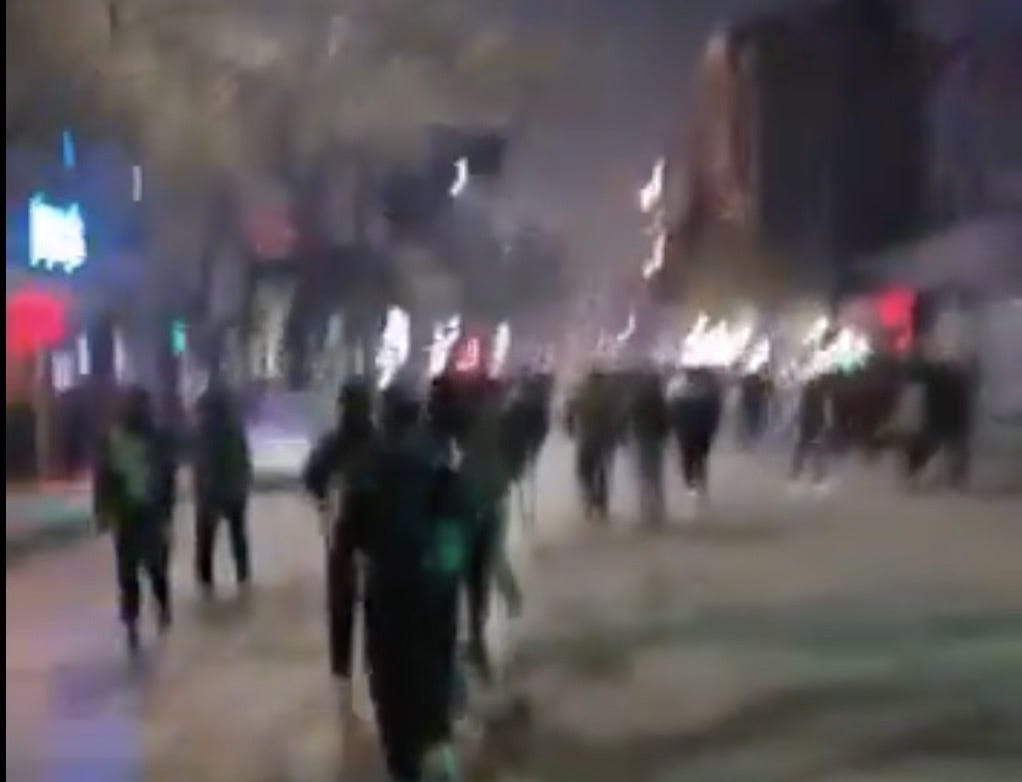
For more than 10 days Iranians across dozens of cities have been spilling out into the streets in another major round of protests, the biggest since the “women, life, freedom” movement that rocked the country beginning in September of 2022. The demonstrations this time were triggered by a currency devaluation that further pressured bazaar merchants, who were the first to take to the streets. They were followed by the students and the young, who generally grab any opportunity to show their opposition to a regime that is universally despised.
The protests have since spread to provincial cities, especially to ethnic minority towns of the country’s border areas and have begun to gather momentum in the big cities.
Iran has been rocked by waves of protests since 1999. Demands have included greater political freedoms and an end to the country’s economic stagnation and international isolations. The protests have become increasingly radical over the years. Calls for reform of the political system eventually gave way to demands for the downfall of the Islamic regime.
Iran’s biggest protests by far were the wave of mass demonstrations triggered by the disputed 2009 re-election of President Mahmoud Ahmadinejad. They drew hundreds of thousands in major cities. They also had the blessing of major factions with the political and clerical elite. That made by far the most threatening to the regime. They went on for months, led to thousands of arrests, and helped the regime fine-tune its repressive apparatus to deal with and eventually squelch subsequent protests.
The Islamic regime in Tehran is one of the worst governments in the world. It combines Soviet-level ideological dogmatism, North Korea-level repression, administrative incompetence, and gross corruption. Iranians deserve better, and they know it.
Because elections offer limited choices and elected officials have little power over Supreme Leader Ali Khamenei and the permanent security apparatus lording over the country, Iranians have few channels for expressing political demands other than protests, and the regime knows it.
The country’s rulers came to power on a wave of mass protests that led to the overthrow of Shah Mohammad Reza Pahlavi’s rule. They have spent the last 47 years making sure they don’t suffer the same fate. They have spent years coming up with strategies to neutralize any attempt at internal regime change. And they’ve become quite good at it.
There is well-informed speculation that the Iranian regime, like that in Algeria and other messy hybrid republics, also allows a certain amount of protests as a safety valve. Protests are also an effective way to identify troublemakers. The cops record the protests. They identify those leading the chants and guiding the other protesters. They dispatch intelligence officers to round the emerging leaders up in the pre-dawn hours. They sentence them to months and years in prison, where they are subjected to mental torture and physical duress. They are released but kept under near constant surveillance.
I and others have written Iranian protests lacking organization and leadership mostly fail to amount to significant political shifts. But Iran’s waves of street actions can nevertheless push change. The 2009 uprising likely convinced Khamenei to stop fiddling brazenly with election results. The “woman, life, freedom” marches ushered unmistakable cultural changes and the abandonment of the enforcement of dress codes on women.
But except for those in 2009, Iran’s protests have not offered any possible roadmap to substantive political change. Iranians seem to sense this, and the numbers of protesters in the big cities have thus far failed to match the crowds gathering in provincial towns, like Abdnanan in the largely Kurdish border region.
The truth is that protests in and of themselves are scary to the bulk of Iranians. They see people fighting in the streets. They hear foreign leaders abroad threaten their country just months after it was bombed. Like ordinary people they stay from crowds, denying protests the critical mass they need to be effective. They stay home because more than freedom, the bulk of Iranians cherish order, nazm, above all. Iranians realize that regime collapse or foreign intervention could worsen their economic plight and threaten their security.
I say this as someone who has lived among Iranians my whole life and in Tehran for years. I speak the language and have been in the middle of all sorts of protests in Iran as a journalist covering the country for decades. The Islamic Republic deserves to be swept into the dustbin of history. But the harsh reality is that there will be no soft transition away from it. Any regime change will likely be violent, prolonged, and destructive.
Here are some other tough truths:
Iran is a powderkeg. I remember those who told me confidently in 2003 that Iraqis are not as reckless as the Lebanese and won’t fight each other along sectarian lines, that Syrians were “civilized” unlike those “tribal” Iraqis who bombed and shot each other in waves of mass killings after the US invasion, and that Libya was too rich and too homogenous to disintegrate. Iran has as many if not more ethnic, religious, class, and regional cleavages as its Middle East neighbors. It is also loaded with small arms and young men trained during their mandatory military service to use them. It could easily explode or collapse.
The regime is cornered and dangerous. Khamenei is in trouble and he knows it. The country’s strategic position and deterrence capabilities have been degraded by the US and Israeli airstrikes last summer, which also showed the ineffectiveness of the alliances it has built with Russia and China. Its economy is collapsing, and its strategy of pivoting east has utterly failed. The decent thing for Khamenei to do would be to announce that he would step down and hand power to a transitional body. But that’s a fantasy. More likely the regime will double down on violent repression at home and seek to rebuild its deterrent capabilities abroad. They believe they have no choice. A few regime hangers-on may have second homes in Toronto, but the core of the clerical and security establishment consists of true believers. They have no desire or even ability to flee abroad. They will fight and kill to stay in power. The regime has extraordinary tools of repression and psychological warfare at its disposal, many of which it has yet to deploy against the protesters. For example, it has yet to deploy the uniformed soldiers of the Revolutionary Guard and the armed forces. In a sign of its confidence, it has yet to even fully shut down the internet, as it has in the past.
Reza Pahlavi can’t save Iran. The son of the deposed shah, is ill-equipped to serve as a transitional figure. If he tries to do so it will likely be a disaster for Iran and for him. It’s not just that he is an uncharismatic intellectual lightweight. He is barely even Iranian. He has lived in the US for nearly 50 of his 66 years and has accomplished little during his exile years. Meanwhile, the country is unrecognizable from the pre-revolutionary era. It has also transformed dramatically in the last 20 years. Parts of the country are lawless, closer to Yemen than Turkey. Ethnic tensions persist. Economic inequality is rife. Pahlavi is a guy who can barely run a coherent opposition movement abroad, much less oversee a volatile, ethnically and religiously diverse country in nestled between Iraq and Afghanistan.
The US can’t help. Don’t believe Iranians abroad and self-described experts who demand that America, Europe, and others “do more” to support the protests. There is nothing they can do to help. The US continues to be toxic for many in the Middle East and Iran, especially given its track record in Iraq and the Arab Spring and its support for Israel during its prolonged assault on the people of Gaza. Any kinetic action in support of the protests would likely backfire. Western support for human rights in Iran also looks hypocritical given the West’s silence over human rights abuses by Israel and the Gulf states.
None of this is to say that ordinary people shouldn’t strongly back the protesters and boost their messages. I strongly support the Iranian protestors, and you should, too. I hope their bravery leads to positive change. Already there are signs that the government is adopting a different strategy in grappling with the current protests, embracing them at moments as expressions of legitimate grievance.
But I also urge caution and restraint about concluding that they will lead to regime change. Like many Iranians inside the country, I dread chaos. I have watched too many countries in the Middle East spiral into disaster and unrelenting misery as a result of cataclysmic political transformation. I don’t want the Islamic Republic. No one sane does. But also don’t want to see tens of millions of Iranians endure the type of suffering and deprivation experienced Syrians, Iraqis, Libyans, Afghans, and too many others in the region.
(Please excuse any typos.)